New DfE EdTech Certification Scheme: What UK Schools Need to Know
The DfE is proposing a new certification scheme for EdTech and AI products. Find out which products would be covered, what safety standards suppliers could face, and what it means for schools.
 Bec May

Rapid advancements in educational technology, particularly AI, are opening up enormous opportunities for UK schools. Teachers can now save hours on lesson planning and admin, while students are benefiting from more personalised learning, rapid skills development, and instant access to research on almost every topic imaginable, all at their fingertips.
But with new technologies entering classrooms quicker than a student rushing out the door for term break, questions around student safety and data protection are becoming harder to answer.
With limited independent assurance about how products process children's information, what safeguards are in place, and how potential risks are managed, schools don't always have the transparency they need to make informed procurement decisions.
The DfE's current consultation on a new EdTech and AI product safety certification scheme aims to change that.
What is the DfE's proposed certification scheme for assuring EdTech and AI product safety?
On 10 November 2026, the Department for Education launched a government consultation titled Introducing a certification scheme for assuring EdTech and AI product safety.
Under the proposal, EdTech companies could have their products independently assessed against defined safety standards, giving schools clearer, more reliable information about the technology they're purchasing and bringing into their classrooms.
The certification scheme aims to simplify procurement, reduce the burden on schools, and give suppliers a consistent way to show their products meet minimum safety standards.
Importantly, the scheme would focus on product safety, not whether a particular technology improves educational outcomes.
So, which products would be covered, and what would companies need to do to achieve certification?
Which EdTech products would be covered?
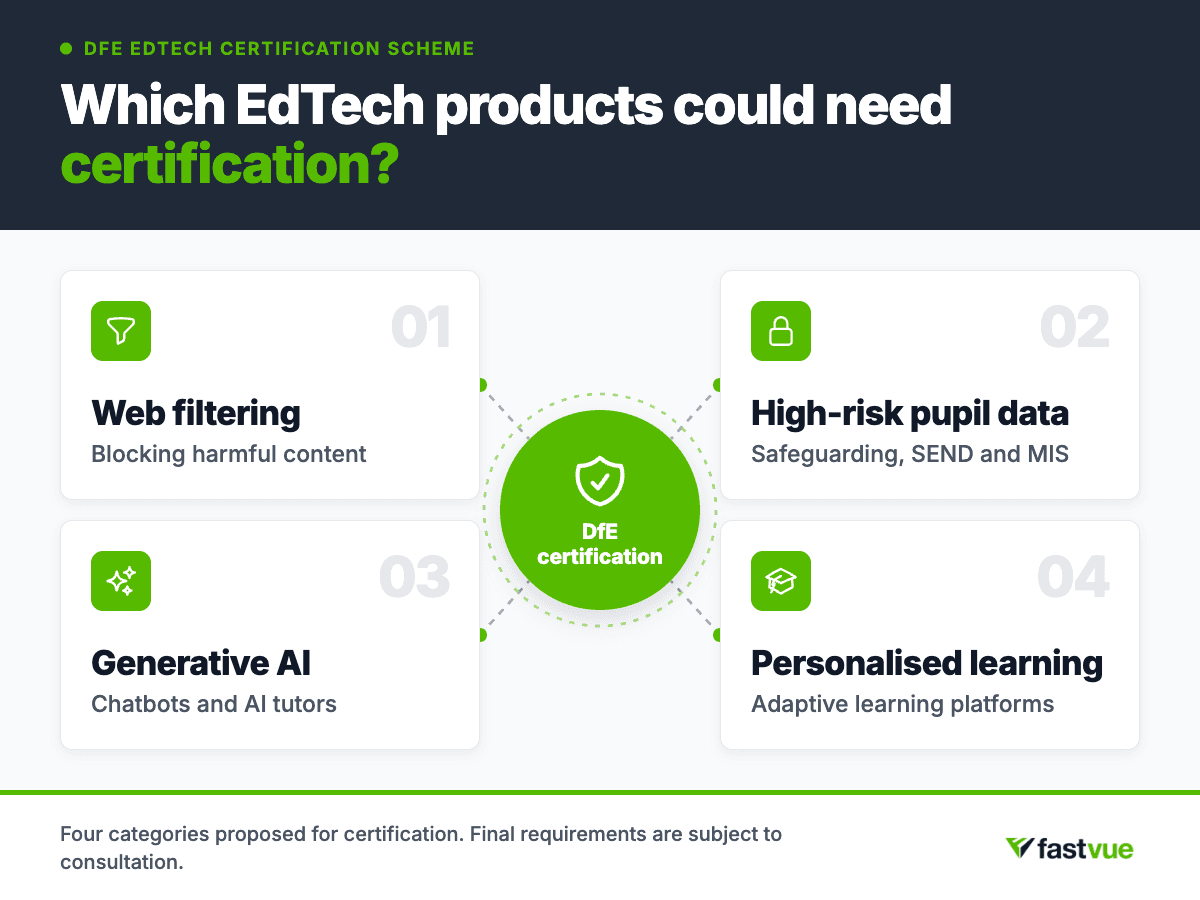
The proposed scheme covers four categories of education technology:
- Web filtering products: Systems designed to prevent pupils from accessing harmful or inappropriate online content.
- Products processing high-risk pupil data: Including certain safeguarding systems, SEND platforms, wellbeing tools, and management information systems (MIS).
- Pupil-facing generative AI tools: Including chatbots, tutoring systems, and content-generation tools. Examples include Khanmigo by Khan Academy and ChatGPT.
- Personalised learning tools: Such as Sparx Maths and CENTURY Tech, which adapt learning activities and recommendations based on individual student progress.
These are examples of the types of technology being discussed, not products confirmed as requiring certification.
Products may fall into more than one category, depending on their features and data-handling practices. Each category would have its own safety requirements, reflecting the different risks associated with the technology.
What safety standards would EdTech companies need to meet?
For web filtering providers, the DfE wants evidence that products can reliably prevent access to harmful content without unnecessarily restricting teaching and learning, a balance it has long emphasised in its Keeping Children Safe in Education (KCSIE) guidance.
Filtering products would also need to provide appropriate protection across school-managed devices, including those used off-site.
The consultation explores whether filtering should go further, including the ability to identify harmful content delivered through images, different languages, and dynamically generated AI material.
For EdTech companies processing high-risk pupil data, the proposed requirements focus on data protection, security, and accountability.
Suppliers would need to demonstrate compliance with relevant data protection legislation, including UK GDPR, and provide evidence of appropriate data protection impact assessments (DPIAs), security measures, and responsible data handling practices.
Generative AI product safety standards: What would certification cover?
Keeping children safe online in education settings has traditionally focused on preventing access to harmful or inappropriate content and, increasingly, monitoring online activity to identify potential safeguarding concerns.
But generative AI introduces another challenge: what happens when the technology itself begins influencing how children think, learn, and behave?
An AI tutor that provides every answer can certainly help a student finish homework on time, but is the student actually learning anything?
An AI chatbot that encourages long, personal conversations may be a great comfort, or it could be hindering the student's real-life emotional and social development.
And a product designed to keep users engaged for as long as possible is probably prioritising maximum screen time over actual educational benefit.
Under the proposed scheme, generative AI products used by pupils would need to meet the DfE's existing AI product safety standards, which cover:
- Cognitive development: Preventing cognitive deskilling, where students become so reliant on AI that they stop practising important thinking and learning skills.
- Emotional and social development: Reducing the risk of unhealthy emotional dependence on AI systems.
- Mental health: Safeguards for situations where students express distress or experience mental health difficulties.
- Age-appropriate design: Taking account of children's ages, developmental stages, and additional needs to provide age-appropriate experiences.
- Manipulative design: Preventing features that exploit children's vulnerabilities or encourage harmful patterns of use.
The standards also cover filtering and monitoring, governance, and how AI systems are designed and tested.
The aim isn't to discourage schools from using AI. It's to ensure the companies developing these products can demonstrate that children's safety and development have been considered in their design, not treated as an afterthought.
For schools and other education settings, independent certification could provide greater clarity about how these risks have been assessed, rather than relying solely on product descriptions and assurances from developers.
What about school monitoring software?
Interestingly, the DfE isn't proposing a separate certification category for technical monitoring products, at least initially.
The consultation draws the same distinction as the DfE's Keeping Children Safe in Education (KCSIE) guidance: filtering prevents access to harmful content, while monitoring helps school staff identify, investigate, and respond to potential safeguarding concerns.
The DfE argues that effective monitoring depends on more than the technology itself. Schools also need clear processes for reviewing alerts, investigating concerns, and taking appropriate safeguarding action.
For this reason, the department believes certifying monitoring software alone may provide limited assurance about safeguarding outcomes.
However, monitoring products could still fall within the scheme if they process children's personal data in ways considered high-risk.
This could include systems collecting detailed search histories, user activity, communication records, or other sensitive pupil information, depending on how that information is processed.
The DfE is seeking views on whether technical monitoring products should remain outside a dedicated certification category.
Microsoft and Jisc are also discussing AI safety in education
The DfE consultation isn't the only development putting pressure on technology companies to demonstrate how they're protecting students.
In September 2026, Microsoft signed a new AI Safety and Privacy Standard with the American Federation of Teachers (AFT) and United Federation of Teachers (UFT).
The agreement introduces legally enforceable protections that US school districts can incorporate into their Microsoft contracts, including restrictions on using student data to train AI models; independent audits and certifications covering security, privacy, and AI governance; greater transparency for parents; and human oversight of important AI decisions.
Similar conversations are now taking place in the UK.
According to The Digital Staffroom, Jisc has confirmed it is in discussions with Microsoft about AI, working alongside government and UCISA, the professional body for IT leaders in higher and further education.
Those talks are ongoing, and there has been no announcement that the US agreement's protections will be extended to UK schools.
Meanwhile, the Information Commissioner's Office (ICO) has welcomed the DfE's proposed certification scheme and confirmed discussions about a new EdTech Code of Practice to strengthen protections around children's data.
Although these are separate developments, they point to higher expectations for technology providers to show how their products protect children and handle personal information.
Could Ofsted check whether schools use certified products?
Potentially.
Under the current proposal, certification would initially be voluntary. This is partly because the DfE doesn't currently have the specific powers needed to force EdTech developers to certify their products or require schools to purchase only certified technologies.
However, it is considering adding an expectation to Keeping Children Safe in Education (KCSIE) that schools obtain appropriate safety assurance when choosing relevant EdTech products.
Certification would ordinarily provide that assurance, although other credible evidence could be accepted where justified.
Ofsted could also consider how schools approach product safety assurance when inspecting safeguarding arrangements.
The DfE makes clear that schools should not be held responsible for product failures outside their control.
How would certification work, and how often would products need recertification?
Under the proposals, independent assessment bodies accredited by the United Kingdom Accreditation Service (UKAS) would assess products against the relevant safety standards.
Certified products would appear on a public register, giving schools a straightforward way to check their certification status.
The DfE is proposing:
- Every three years: Full recertification for filtering products, high-risk data processing products, and personalised learning tools.
- Annual checks: Targeted assessments between full certifications to confirm products continue meeting the requirements.
- Potentially every year: Full recertification for generative AI products, reflecting the pace at which AI technologies are changing.
Significant changes to a product could also trigger reassessment before its existing certification expires.
The DfE's preferred approach is to own the certification scheme while accredited independent bodies carry out the assessments.
Do enterprise-grade firewalls give schools greater control over pupil data?
The DfE's proposed scheme would require EdTech providers processing high-risk pupil data to demonstrate compliance with data protection legislation and provide evidence of appropriate safeguards.
For schools in England, this brings the way their filtering and monitoring systems handle pupil data into sharper focus.
Even when a school's firewall is installed on-premises, its reporting platform may be cloud-hosted, meaning student internet activity logs are transferred to an external service for analysis and storage.
An enterprise-grade firewall can filter internet traffic and generate logs of student online activity. A separate firewall reporting platform collects and analyses those logs, turning them into internet usage reports, user activity histories, and safeguarding alerts.
Schools using an enterprise-grade firewall alongside locally deployed reporting software, however, can keep their core reporting data within infrastructure they control.
This gives schools greater control over where sensitive pupil information is stored, who can access it, and how long it's retained.
While using an on-premises firewall and reporting platform won't automatically guarantee data protection compliance, it does give schools more direct control over their monitoring data rather than relying entirely on a third-party reporting provider.
Where Fastvue Reporter fits
Fastvue Reporter works with leading enterprise firewalls to give schools a clearer picture of student online activity, without requiring their core reporting data to be stored on a third-party cloud platform.
Installed on-premises or in a school-managed private cloud, Fastvue Reporter allows schools to control where their internet activity records are stored, how long they're retained, and who can access them.
The Safeguarding Report identifies potentially concerning online behaviour, including searches relating to self-harm, bullying, and other safeguarding risks. Real-time alerts help bring urgent concerns to the attention of the right staff, while Internet Usage and Activity reports provide the detail needed to investigate further.
Schools can also extend their monitoring to email and chat, currently through Microsoft 365, and enable optional AI Risk Assessment to help prioritise safeguarding concerns.
For schools that choose to use AI Risk Assessment, only selected activity associated with safeguarding keyword matches is submitted for AI analysis. Personal identifiers are redacted before the information is sent to the external AI service, rather than sending complete, identifiable student activity histories to the cloud. The information is not used to train AI models.
This gives schools the flexibility to use AI to help assess potential safeguarding risks while retaining control over their core reporting infrastructure.
Fastvue's deployment options do not automatically establish compliance with future certification requirements, and the final scope of the scheme has yet to be decided.
Explore Fastvue Reporter for Education
What happens next?
The DfE consultation closes on 4 February 2027, with a government response expected in spring 2027.
If approved, the scheme would take at least 18 months to establish before the first products could be certified, followed by a transition period for suppliers and education settings.
For EdTech companies, the proposals would introduce a clearer way to demonstrate that their products meet recognised safety standards.
For schools, it could mean less guesswork when choosing new technology, with independent safety assessments and a public register of certified products to help inform purchasing decisions.
The consultation is open to schools, teachers, safeguarding professionals, technology suppliers, parents, and anyone else with an interest in how EdTech is used.
Read the DfE consultation and have your say
Frequently asked questions about the DfE EdTech certification scheme
Is EdTech certification mandatory for schools in England?
No. The proposed EdTech certification scheme would initially be voluntary. However, the DfE is considering updating Keeping Children Safe in Education (KCSIE) to expect schools and other education settings to obtain appropriate safety assurance when purchasing relevant EdTech products. Independent certification would ordinarily provide that assurance, although other credible evidence could also be accepted.
When will the DfE EdTech certification scheme come into effect?
There is no confirmed implementation date. The consultation closes on 4 February 2027, with a government response expected in spring 2027. If approved, the DfE estimates the scheme would take at least 18 months to establish before products could begin receiving certification, followed by a transition period.
Will generative AI products have to monitor student prompts and responses?
Under the proposed scheme, pupil-facing generative AI products would be assessed against the DfE's existing AI product safety standards. These include maintaining appropriate activity logs of prompts and responses, identifying potentially harmful content, and providing mechanisms for alerts and human intervention when safety concerns arise. The standards are designed to ensure AI features support learning while providing appropriate safeguards for children.
How would EdTech certification protect children's personal data?
EdTech companies processing high-risk pupil data would need to demonstrate compliance with relevant data protection legislation, including UK GDPR and the Data Protection Act 2018. The proposed requirements include evidence of a Data Protection Impact Assessment (DPIA), appropriate cyber security measures, and compliance with relevant ICO guidance. Certification would provide independent assurance about product safety, but it would not replace existing legal responsibilities.
Who is responsible for student data when schools use EdTech products?
Schools are generally the data controllers for personal information processed on their behalf, while EdTech providers often act as data processors. However, these roles depend on who determines the purposes and means of processing. Both must meet their responsibilities under UK GDPR, including ensuring personal data is processed securely and has an appropriate lawful basis. Suppliers must also be transparent about how information is collected, used, and shared.
Would certified AI products still require human oversight?
Yes. Certification would not replace human judgement, particularly when AI products identify potential safeguarding concerns or contribute to decisions affecting children. The DfE's AI product safety standards address monitoring, accountability, and safeguards for children's wellbeing. AI systems may help identify patterns or flag high-risk activity, but school safeguarding staff must still assess concerns and determine the appropriate response.
Could EdTech certification prevent long-term developmental harm from AI?
The proposed scheme aims to reduce risks associated with poorly designed AI products, including cognitive deskilling, emotional dependence, and potential long-term developmental harm. Suppliers would need to demonstrate how their products address these risks through appropriate design, testing, and safeguards. Certification would provide greater assurance that risks have been assessed, rather than guaranteeing that a product could never cause harm.
Does storing pupil monitoring data on-premises improve data protection?
Keeping reporting data on school-managed infrastructure can give schools greater control over where information is stored, who can access it, and how long it's retained. However, on-premises deployment doesn't automatically guarantee UK GDPR compliance or satisfy future EdTech certification requirements. Schools and their suppliers must still ensure that personal data is processed lawfully and protected by appropriate security measures.
How would EdTech products be tested for safety?
Under the proposals, certification could involve more than reviewing a supplier's policies and documentation. Independent assessors could test a product's technical safeguards, examine how it performs in realistic safeguarding scenarios, and deliberately attempt to bypass its safety controls. For generative AI products, this could mean testing how a chatbot responds when a student asks for harmful information, expresses distress, or attempts to get around its restrictions. The DfE is also considering benchmarking products against predefined scenarios and reviewing how effectively safeguarding alerts and escalation procedures work. The aim is to establish whether a product's safety features actually work, rather than simply accepting the manufacturer's claims.
Would EdTech certification cover AI features built into existing school software?
Potentially. Many education platforms now include AI features alongside their existing tools. The DfE is seeking views on how certification should apply to products with multiple functions, particularly where AI capabilities introduce additional safety or data protection risks. The final requirements will determine whether certification applies to an entire product, particular features, or specific configurations.